Think & Discuss
Quick Check
Inquiry Task
What it can support: The alternating appearance of early modern human fossils and later reappearing Neanderthal fossils in the same region shows that the presence of modern humans there was not continuous, and together with the subsequent long-term contraction of the Neanderthal range, it can form a testable chronological sequence. Therefore, the claim that "the first wave did not occupy the region long-term and only the second wave brought substantive dispersal" has archaeological plausibility. What it cannot support: The presence or absence of fossils only shows that "someone left remains here"; it cannot directly show "who defeated whom." The absence of a particular type of fossil in a given stratum does not mean that population was not present locally at the time. Limited sample sizes, dating errors, and regional limitations also make it difficult to distinguish among competition, disease, climate, and population fluctuations as separate causes. It is therefore a supporting line of evidence, not conclusive proof.
The first type is comparative archaeological evidence, such as symbolic objects, ornaments, long-distance exchange networks, or traces of complex hunting organization from the two populations, used to compare differences in behavioral complexity. Its limitations: artifact makers cannot always be reliably matched to specific populations, dating has margins of error, and differences in behavioral complexity do not necessarily equal differences in cognitive ability. The second type is genetic evidence related to population history, such as admixture proportions, population sizes, and divergence times from modern and ancient human samples, used to determine whether long-term contact and gene flow occurred. Its limitations: genetic data can reveal admixture and population size but cannot directly measure language or fictional capacity; moreover, climate and environmental data must be included as competing explanations in the comparison to determine whether cognitive advantage played a key role among the various factors.
A common intuition is that Neanderthals were a backward species overtaken by Homo sapiens. But when you straighten out the timeline, the order is exactly the opposite. Neanderthal ancestors left Africa about 400,000–600,000 years ago and evolved independently in Eurasia—they were the region's "locals." Homo sapiens only appeared in East Africa about 100,000 years ago (this book adopts this estimate; fossils such as Omo Kibish and Herto in East Africa are older, dating back to about 160,000 years ago or even earlier), making them the later arrivals.
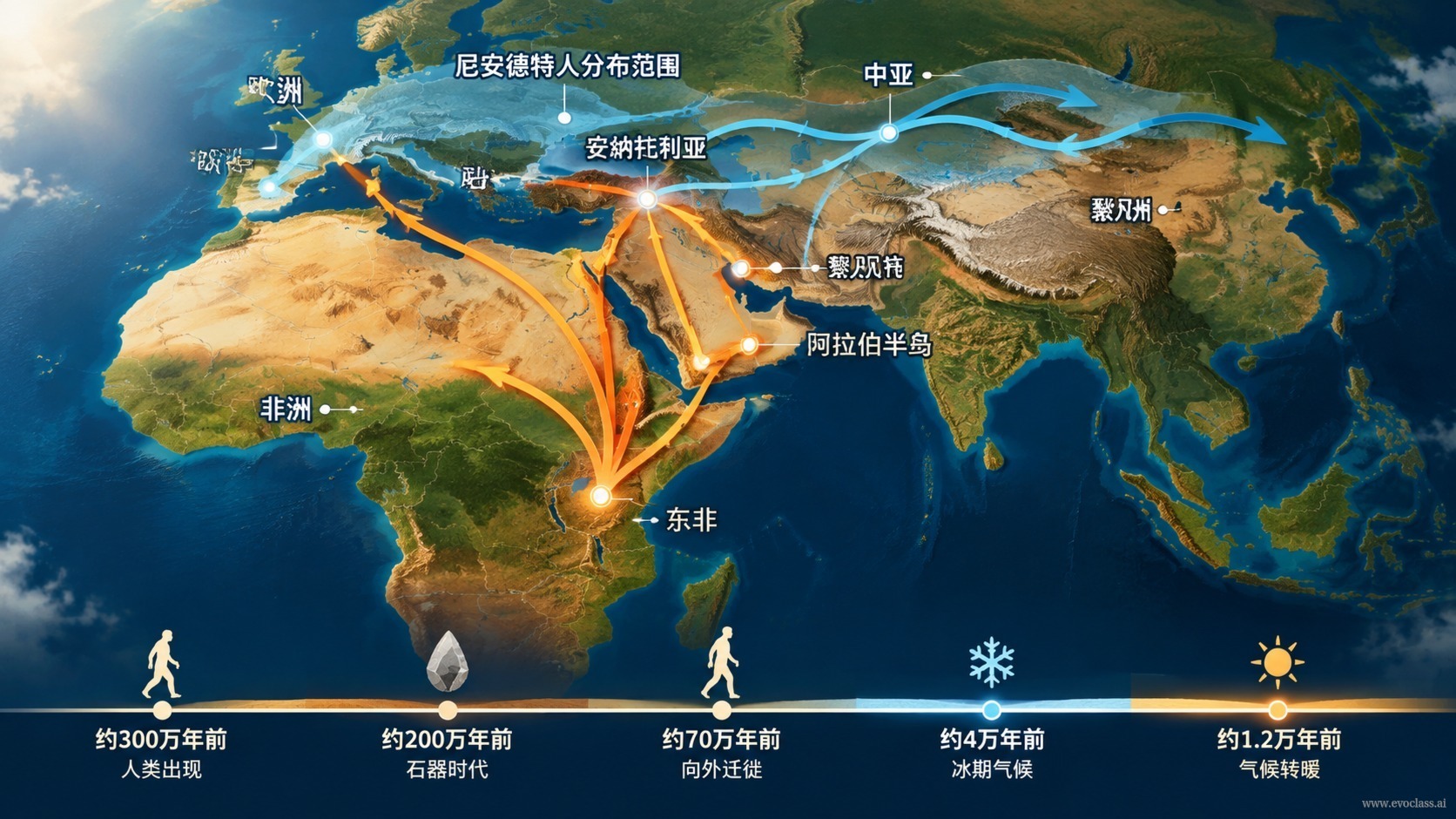
- About 400,000–600,000 years ago: Neanderthal ancestors left Africa and evolved in Eurasia.
- About 100,000 years ago: Homo sapiens appeared in East Africa; the "first out-of-Africa migration" reached the Levant but failed to occupy Eurasia long-term, subsequently disappearing or retreating locally.
- About 70,000 years ago: The "second out-of-Africa migration" began, coinciding with the effective starting point of modern human global dispersal.
- About 40,000 years ago: The Neanderthal range continued to contract, leading to extinction.
In the Skhul and Qafzeh caves of the Levant, early modern human fossils and later reappearing Neanderthal fossils alternate in the same region, serving as an archaeological clue for "the first wave failed to gain a foothold, and only the second wave created dominance." Note: this clue indicates the relative order of appearance and alternation, not the direct cause of "who defeated whom."
This book aligns the second out-of-Africa migration about 70,000 years ago with theCognitive Revolutionin time, and on this basis proposes a core claim: the key to Homo sapiens' victory was not physical constitution, butthe ability of language and fictional storytelling—it is precisely this ability that sustains large-scale, flexible cooperation, enabling Homo sapiens to rapidly organize actions on a scale far beyond that of small groups in unfamiliar environments.
But "replacement" does not involve only one mechanism.Niche overlap, resource competition, disease transmission, and interbreedinglikely occurred simultaneously; "conflict" is only one explanatory pathway and cannot be reduced to a single-line racial war. Thinking of the competition as a multiple-choice question is closer to the current research picture than imagining it as a single arena match.
| Comparison Dimension | Neanderthals | Homo sapiens |
|---|---|---|
| Time of Arrival in Eurasia | Arrived about 400,000–600,000 years ago; evolved locally and independently | Appeared in East Africa about 100,000 years ago; began large-scale dispersal about 70,000 years ago |
| Capabilities and Behavior | Brain volume slightly larger than modern humans; used fire, made tools, buried their dead, possibly had symbolic behavior, and were highly adapted to the cold Eurasian environment | Used language and fictional storytelling to sustain large-scale cooperation |
| Outcome | Went extinct about 40,000 years ago, but left traces in modern human genes | Became the common ancestor of all modern populations today |
The mainstream explanatory framework is the "recent African origin plus partial admixture" model: modern populations outside Africa universally carry about1%–4%Neanderthal DNA, indicating that the replacement process was not purely substitution or extinction but also involved competition, isolation, and interbreeding.
Finally, an academic caveat must be preserved: designating about 70,000 years ago as the "burst point" of the Cognitive Revolution is essentially anarrative simplification. Symbolic behavior at sites such as Blombos Cave in South Africa dates back to about 100,000 years ago, and whether cognitive ability was a "mutation" or "gradual accumulation" remains debated in academia. When reading, treat fossil dates and genetic data as evidence, treat "Homo sapiens won through storytelling" as this book's interpretive claim, and remain attentive to competing explanations such as climate, population, and disease.
From East Africa to the NeanderthalsObserve the migration route timeline map, marking East Africa, the Middle East, Europe, and the Neanderthal range, and consider how it relates to "Homo sapiens competing and even clashing with Neanderthals and other human species during their expansion."